

Do You Click on Billboards?
Since the inception of the internet, businesses and individuals have been trying to figure out how to make money off of it. One of the clearest, and sometimes most infamous, ways businesses make money off the internet is through advertising.
And one of the most exciting things the internet brought to the world of advertising was the ability for the users to interact with the advertisement. This interaction could be captured, catalogued, and tracked. This interaction was given the highly imaginative name of “click”.
Companies that eagerly moved into online advertising were excited that they could see the clicks. They couldn’t see this with television, newspaper, magazine, or billboard ads. This was something tangible, it was a step up from these other non-interactive mediums.
Online ad agencies saw the excitement that the interactive “click” brought to their prospective customers and certainly weren’t going to dissuade them. If the click was what was drawing customers in, then there was no need to tout any other values. “Yeah, the click makes us better!” they would say. And people believed them, because it was true—sort of.
But you see, hiding in the shadows, there was a stowaway—a lie that hitched a ride with the truth that the ability to track a click was a good thing. This lie was that the click was all that mattered.
Do television ads still work? The easy answer is, of course they do. Despite the fact that online advertising is growing at a rapid pace, tens of billions of dollars are spent on television advertising each year. And despite the fact that print is declining, it also still accounts for billions in advertising dollars. And you can’t click a T.V. (yet) or a newspaper or magazine. You can’t click a billboard. But it still works.
The most overlooked aspect of online advertising is the fact that ads that were seen, but not clicked, still influenced behavior. In fact, studies have shown that more money is made on ads that were seen, but not clicked than on ads that were clicked on. Let’s say that again. Most online marketing campaigns close more deals and make more money off of online visitors who saw the ad, but didn’t click than they do off of those who clicked on the ads. And here’s why:
Let’s imagine that we’re running an online ad campaign and that the click-through rate we get is 1% (which is higher than today’s industry average for click-through rates). This means that if 1000 people saw the banners, 10 would have clicked. If 30% of those who clicked on the banner purchased, then we would have conversions among those who clicked. However, we still have 990 people who only saw the banner and if only 7% of them purchase, then this means that we would have 70 purchases. Thus, the conversion rates were lower with our “Post-Impression” group, because they only had a 7% conversion rate—compared to a 30% conversion rate for those who clicked, but the actual number of conversions was higher for those who only saw the banners. The following chart uses one of DeepTarget’s customer campaigns actual results to illustrate the larger number of conversions from those who only saw the banner.
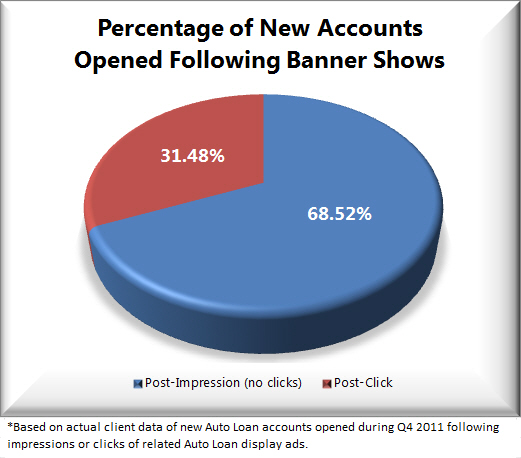
One study, published by emarketer.com, notes that almost eighty percent of conversions come from those who saw an ad, but didn’t click (see the Post-Impression stat on the second chart):
http://www.emarketer.com/Article.aspx?R=1008045
Another study, also by emarketer.com, gives some reasons why people would be interested in the product they see in an online ad, but would choose not to click:
http://www.emarketer.com/Article.aspx?id=1008620&R=1008620
So, knowing your click-through rates is good, but if you let the story stop there, you’re missing the best part.